Table of Contents
Personalize your Shopify products
Install for freeEstablished sellers who scale in 2027 will be the ones who tighten three things in Q1: what they sell, how they sell it, and how they get paid.
This playbook comes from three teams that work with growing stores every day: Printbelle (print on demand), Customily (product personalization) and WorldFirst (cross-border payments). If your store already has steady sales and you want to grow without adding chaos, these five moves are for you. They are practical, they can start this month, and each one builds on the last.
1. Double down on your winners before adding new products
The fastest way to grow in Q1 is to put more weight behind what already sells, not to widen the catalog. Pull your last 12 months of orders and sort by revenue and by margin. Most stores find that a small share of products drives most of the profit.
- Pick your top 3 to 5 products and build variations around them (new designs, sizes, occasions, bundles).
- Retire or pause products with low margin and high support cost.
- Order samples before scaling any new item, so quality is confirmed before ad spend goes behind it.
- Choose a print on demand partner with consistent quality and delivery times you can promise to customers.
📌 Printbelle tip: Think beyond Q1. Use Q1 as your testing ground to identify winning products and designs, then scale them throughout Q2 and Q4. Focus on evergreen product categories that work from Valentine's Day in Q1 to Mother's Day and Father's Day in Q2, and Christmas in Q4. Strong examples include home décor (canvas prints, posters), drinkware (mugs, tumblers) and apparel (T-shirts, polo shirts).
By testing and optimizing these products early, you can reuse winning designs, adapt them to different occasions, reduce development costs and maximize your ROI throughout the year.
2. Make your best sellers worth more with personalization
Personalized products let you charge more for the same base item and stand out from stores selling the same blank. For established sellers, the goal is to add personalization where it moves the numbers, not everywhere at once.
- Start with your top sellers from step 1, since traffic and proof are already there.
- Let customers upload photos or add names and see a live preview, so they buy with confidence and you get fewer questions and returns.
- Offer a few smart options (names, dates, photos, text styles) instead of a long list that slows buyers down.
- Track conversion rate and average order value before and after, so you know what personalization adds.
📌 Customily tip: Design once, personalize for every occasion. Instead of building a new product for each holiday, create one personalization template (a name, a date, a photo or a message) and reuse it from Valentine's Day to Mother's Day and Christmas. Customers see a live preview before they buy, and every order generates its own print-ready file automatically, so a busy week does not mean more manual work.
Then choose a tool with people behind it. If something breaks during a peak week, Customily's support team answers by live chat with real people, and one-on-one training and weekly live classes help your team get the most out of the tool.
Take WoodBull, a gift brand that added real-time personalization with live preview, photo uploads and custom text. Its first personalized barbecue kits became an instant bestseller, and monthly revenue grew by over 43% compared to the previous period.

3. Protect your margins by getting paid smarter
As you scale, payment costs stop being a rounding error. Currency conversion, transfer fees and slow payouts quietly eat into the margin you worked to build in steps 1 and 2.
- Review what you lose each month to fees and exchange rates across your sales channels and suppliers.
- If you sell in several markets, look at collecting and holding money in more than one currency instead of converting every payment immediately.
- Keep business money separate from personal money, so reporting and taxes are simpler.
- Plan cash flow around payout timing, especially before peak seasons when you need to pay for stock, ads and production.
📌 WorldFirst tip: Treat your payment setup as a lever for protecting margins, not just a back-office task. For international sellers, FX costs can quietly eat into profit on every order, especially when funds are converted often or across multiple currencies. A multi-currency account can help you receive and hold funds in currencies such as USD, EUR, GBP and BRL, giving you more flexibility to convert when it aligns with your cash flow needs. New WorldFirst users in the EU can also access a 0.3% discounted FX fee for 180 days, helping reduce conversion costs during an important growth stage.
Your everyday business spending can protect margins too. For recurring costs such as supplier payments, advertising and SaaS subscriptions, the World Card offers unlimited cashback on eligible spending, with rates varying by region. This lets you recover part of your regular operating costs, turning necessary expenses into a small but measurable margin advantage.
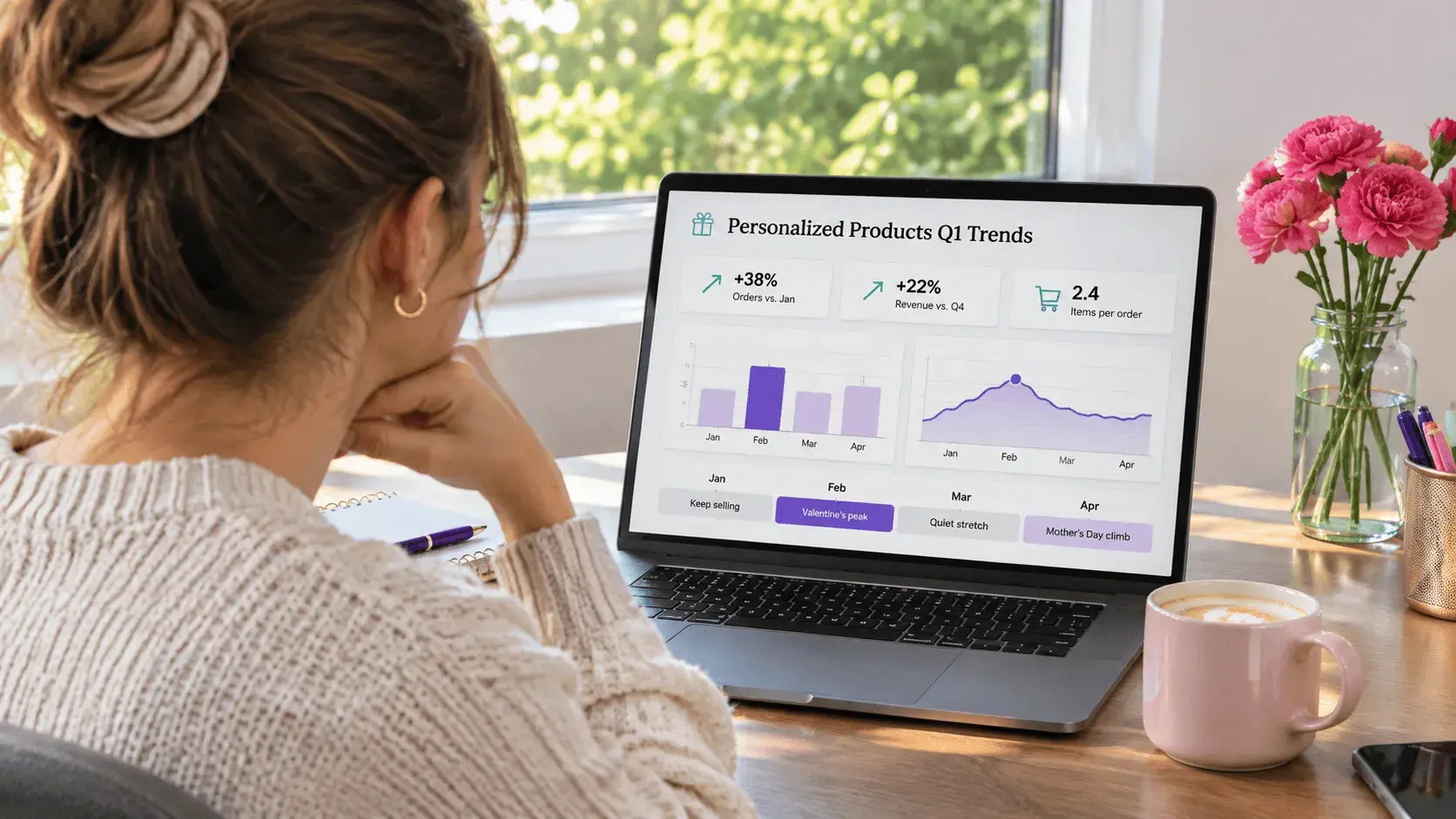
4. Build your Q1 calendar now, not in January
Gifting seasons arrive faster than most sellers expect, and personalized products need extra lead time for designs, approvals and production. Plan backwards from each date.
For each date, set three deadlines: design ready, ads live and last day to order. Share the last day to order clearly on your store so customers know what to expect.
The numbers behind your Q1 and Q2 plan
Last year's results show how big the spring gifting windows have become. Use them as a baseline for your 2027 targets.
Online is also the top Valentine's Day shopping destination (38% of shoppers), ahead of department stores (35%) and discount stores (30%).
Ads usually get cheaper right after the holidays
One US benchmark put Meta CPMs at about $25.49 in Q4 2025 versus roughly $20.96 in Q1, with January 2026 as the low point at $17.12. Costs then climbed again through spring. That makes January and February a good window to test creatives and offers before Mother's Day competition builds.
Payment costs add up as you scale
Standard card processing often runs around 2.9% plus a fixed fee, and it costs more for international cards and cross-border payments. One industry analysis estimates that many cross-border merchants lose a 2% to 4% margin gap to FX spreads, platform conversion fees and settlement timing. As an illustration, a 2% gap on $500,000 in yearly sales is $10,000 a year.
Wall art and home decor are growing
Apparel still leads print on demand, but wall art, homedecor and drinkware are growing fast, and one forecast expects the wall art segment to double by 2030. For established sellers, that is a natural place to extend a winning personalized design into new products.
Q1 and Q2 by the numbers
The two biggest gifting moments before summer are growing, and shoppers are asking for something unique, which is exactly where personalized products fit. These are the 2026 benchmarks to plan against (data as of November 2026).
What the numbers mean for your store
- The gift list keeps growing. For Valentine's Day, 58% of celebrating shoppers plan to buy for family members ($4.5B), 33% for friends ($2.4B), 27% for children's classmates and teachers ($2.2B) and 21% for co-workers ($1.7B). A record 35% will also buy for pets ($2.1B). Think beyond couples: family sets, teacher gifts and pet items.
- Shoppers want something different. For Mother's Day, 46% say finding something unique or different is the most important factor, ahead of creating a special memory (39%). Personalized gifts answer that directly.
- Mother's Day is a bigger, higher-budget moment. Shoppers plan to spend a record $284.25 on average, and 54% of celebrants plan to buy for their mother or stepmother, 22% for a wife and 13% for a daughter. Build your offers around those three buyers.
- Personalization is a baseline expectation. In McKinsey's research, 71% of consumers expect personalized interactions, 76% get frustrated when they do not get them, and 78% say personalized content makes them more likely to repurchase. McKinsey also reports that personalization most often drives a 10 to 15 percent revenue lift.
- Q1 starts with returns. NRF and Happy Returns estimate that 19.3% of online sales were returned in 2025, and retailers expected 17% of holiday sales to be returned. Among shoppers, 82% say free returns are a major consideration, and 71% are less likely to shop with a retailer again after a poor returns experience. Clear previews and approvals before production help you avoid returns on personalized items. Make your returns policy easy to find before January.
5. Automate the routine and choose partners that answer
Growth breaks the processes that worked at a smaller size. The sellers who keep scaling remove manual steps early and rely on partners who respond fast when something goes wrong.
- List the tasks you repeat every week (order checks, file preparation, payment reconciliation) and automate the top three.
- Connect your tools so orders, production and payments flow without copy and paste.
- Before committing to a partner, test their support: how fast do they reply, and do you talk to a person?
- Ask for training. A tool you fully use is worth far more than one you barely touch.
- The right stack is not the longest one. It is a small set of tools that work together and have people behind them.

Make 2027 your strongest year yet
The gap between a good year and a breakout year is rarely one big move. It is a handful of deliberate choices made early: back your winners, add value with personalization, protect your margins, plan around the calendar and work with partners who pick up when you need them.
You do not have to do everything at once. Choose one move from this list and start it this week, then add the next in December. By the time Valentine's Day orders arrive, your store will be ready for them while others are still catching up.
Printbelle, Customily and WorldFirst are here to help you build that foundation.
Let's make 2027 the year your store scales with confidence 🚀
Frequently asked questions
How should established sellers prepare for Q1 2027?
Tighten three things before January: what you sell, how you sell it and how you get paid. In practice, that means backing your top 3 to 5 products, adding personalization to your best sellers, reviewing payment and FX costs, building your Valentine's Day and Mother's Day calendar early and automating the tasks you repeat every week.
When should I start preparing for Valentine's Day and Mother's Day 2027?
Now. Valentine's Day 2027 falls on Sunday, February 14, so set your last day to order early enough for delivery by Friday or Saturday. Mother's Day in the US is Sunday, May 9, 2027, but start designs and ads in Q1. Ad costs are usually lower in January and February, which makes it a good window to test creatives and offers.
Is personalization worth adding to products that already sell?
Usually, yes. Your best sellers already have traffic and proof, so personalization adds value where buyers are already converting. Keep options short (names, dates, photos, text styles), show a live preview and compare conversion rate and average order value before and after. WoodBull grew monthly revenue by over 43% after adding personalization to its barbecue kits.
How do I add personalization without adding manual work?
Use a tool that creates the print-ready file for every order automatically. With Customily, you build one personalization template and reuse it across occasions, from Valentine's Day to Christmas. Shoppers add names or upload photos with the Image uploader and see a live preview before they buy. Customily works with Shopify, Etsy, Amazon and more, and you can try it free for 9 days.
Which print on demand products work all year?
Evergreen categories that fit every gifting moment, from Valentine's Day to Mother's Day, Father's Day and Christmas. Printbelle recommends home décor (canvas prints, posters), drinkware (mugs, tumblers) and apparel (T-shirts, polo shirts). Test them in Q1, then reuse winning designs for each occasion through Q2 and Q4.
How can I reduce payment and currency costs as I scale?
Start by measuring what you lose each month to card fees, conversion fees and exchange rates. If you sell in several markets, a multi-currency account such as WorldFirst's lets you receive and hold USD, EUR, GBP and other currencies and convert when it suits your cash flow, instead of converting every payment immediately.
When will the 2027 Valentine's Day and Mother's Day spending forecasts come out?
The NRF usually publishes its Valentine's Day forecast in late January and its Mother's Day forecast in late April. Until then, use the 2026 figures in this playbook as your baseline: a record $29.1 billion for Valentine's Day and a record $38 billion for Mother's Day.