Table of Contents
Personalize your Shopify products
Install for freeAfter the holiday rush, it’s tempting to treat January as a slow month: pause the ads, leave the listings alone, and start thinking about Valentine’s Day in February. The data says otherwise.
We looked at more than 70 million shopper personalizations across stores that run Customily on six platforms, including Shopify, Etsy, WooCommerce and Amazon, with a close look at the first quarter of 2025 and 2026. Two things stood out: January sells like a normal month, and Valentine’s shoppers buy almost two weeks before February 14, not the week of.
Here’s what Q1 really looks like for personalized products, and a week-by-week plan for 2027.
January is a normal month, not a dead one
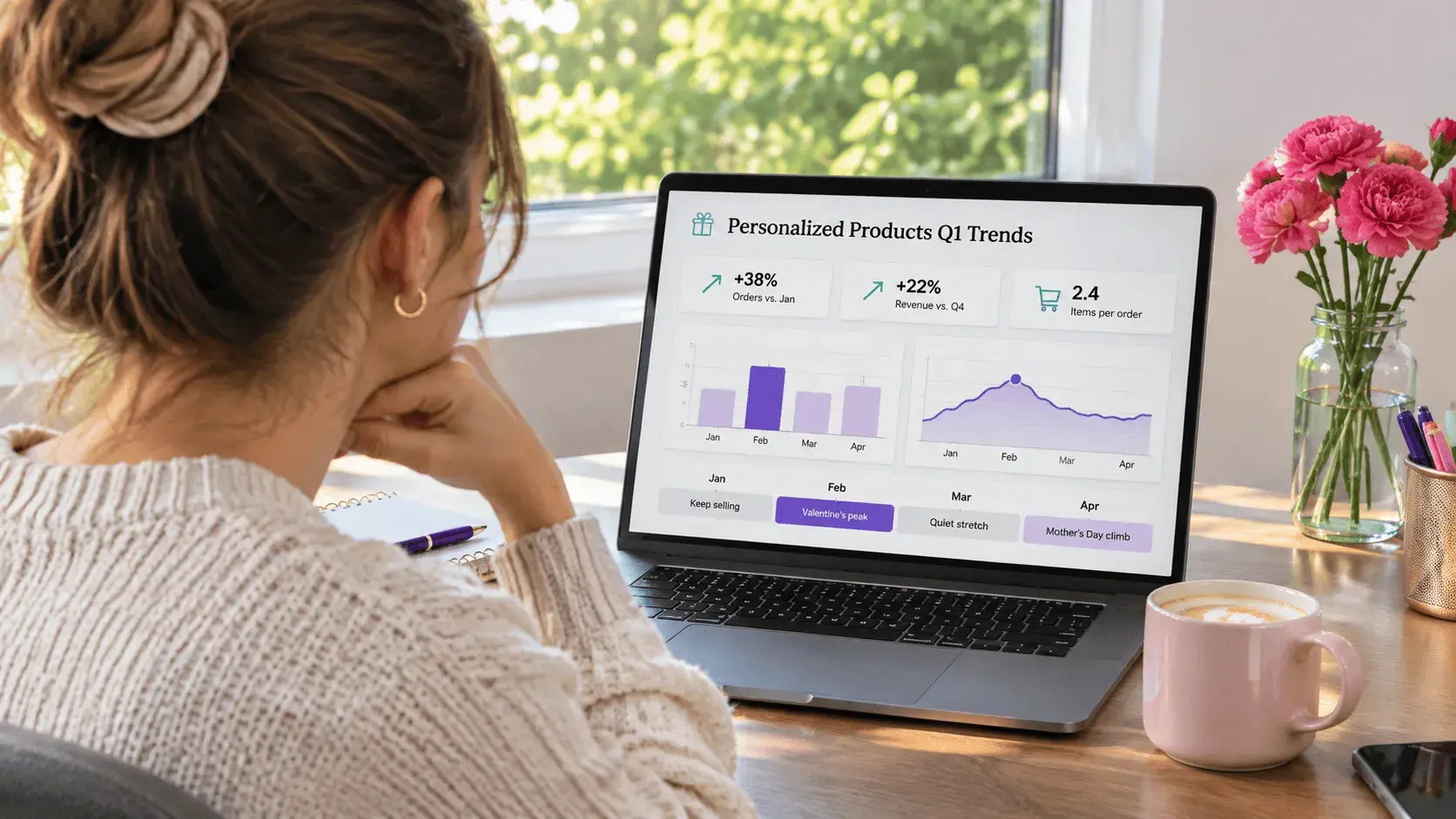
Over two years, January landed close to a typical month: 96% of an average month in 2025 and 92% in 2026, using January to October as the yardstick. The rest of the year followed the same shape both times: a dip in February and March, a spring bump around Mother's Day, a calmer summer, then the climb from October into the holidays.
Daily activity tells the same story: in January 2025, shoppers personalized about 10% more products per day than in August, and demand grew through the month instead offading.
What to do with it: Don't switch off your store or your ads on December 26. Treat January like any normal month, and use the first two weeks to get Valentine's Day products live: as the next section shows, that demand starts building by mid-January.
Valentine's shoppers show up two weeks early
The busiest Valentine's day isn't February 14. In 2026, the busiest day of the whole quarter was Sunday, February 1, thirteen days before Valentine's Day, and the ten busiest days all fell between January 26 and February 4. On that peak day, shoppers personalized about two thirds more products than on a normal early-January day. In 2025 the pattern was the same, a little flatter: the busiest Valentine's day was Sunday, February 2.
By Valentine's week, most shoppers have already bought. February 14 itself was 42% quieter than the peak in 2026, and 26% quieter in 2025. Delivery time is the likely reason: a made-to-order gift bought on February 10 has little chance of arriving by the 14th.
The opportunity is real. US shoppers planned a record $29.1 billion of Valentine's Day spending in 2026, up from $27.5 billion in 2025, according to the National Retail Federation. A record 35% planned gifts for their pets, and gifts for family members were expected to reach $4.5 billion: Valentine's Day is no longer only about couples.
What to do with it: Have Valentine's products, ads and emails live by mid-January, and put your biggest push on the last week of January and the first days of February. Show a clear order-by date for delivery by February 14, and don't save your budget for Valentine's week; by then the decision is made.

More shoppers, not bigger baskets
Valentine's Day brings a crowd, not a different kind of shopper. In 2026, the busiest Valentine's week drew about 1.5 times as many shoppers as the first week of January. But they bought the way they do all quarter: about 30% of shoppers who personalized a product went on to buy it, and about 1 in 7 orders held two or more personalized items.
2025 looked the same: a smaller crowd at the peak, and the same buying habits as the rest of the quarter. Christmas is the opposite. At the December peak, 36% of shoppers who personalized a product bought it, and multi-item orders went up. Valentine's Day is one gift for one person; Christmas is a list.
What to do with it: Win Valentine's Day with reach, not basket tactics. Put budget into ads and email in late January, and lead with one strong product per recipient instead of bundles. Since more Valentine's gifts now go to pets and family, give those their own products and pages rather than tucking them into a couples collection.
After Valentine's Day: a quiet stretch, then Mother's Day
The two weeks after February 14 are the quietest of the quarter. In 2025, the week of February 17 was about a fifth quieter than early January. March runs steady, with a slow patch in mid-to-late March in both years, and Sunday is the busiest day of the week all quarter long.
Then Mother's Day takes over, earlier than most sellers expect. In 2025, activity jumped by more than a quarter in a single week, the week of March 31: six weeks before Mother's Day on May 11. In 2026, the same jump came in the week of April 6, five weeks before May 10.
What to do with it: Use the late-February lull for catalog work: new designs, better photos, and fixing the product pages that under performed at Valentine's. Have Mother's Day products live by the last week of March. For Mother's Day 2027 (May 9), that means by March 29.
Q1 2027: what to do, week by week
Valentine's Day 2027 falls on a Sunday, so if the pattern of the last two years holds, the busiest day will land around Sunday, January 31. Mother's Day is May 9.
Start Q1 in December
The busiest stretch of the quarter comes before February does. Valentine’s shoppers buy almost two weeks before February 14, and Mother’s Day shoppers show up five to six weeks early. If you start in February, you’ve already missed the peak.
So treat December as Q1 prep. Pick your Valentine’s products, give pet and family gifts their own pages, set a clear order-by date, and have everything live by mid-January. Then put your biggest push on the last week of January, when shoppers are ready to buy.
The products that sell in that window are personalized gifts made for one person. Customily lets your shoppers personalize any product with a live preview, then sends production-ready files straight to fulfillment, on Shopify, Etsy, WooCommerce, Amazon and more. Start your 9-day free trial on Shopify, or book a free demo for any other platform.
Frequently Asked Questions
Do personalized products sell in January?
Yes. January sells like a normal month: it reached 96% of a typical month's orders in 2025 and 92% in 2026.
When do Valentine's Day orders for personalized gifts peak?
About two weeks before February 14. The busiest days were Sunday, February 1, in 2026 and Sunday, February 2, in 2025; February 14 itself was 26% to 42% quieter than the peak.
When should I launch Valentine's Day products?
By mid-January. Shoppers start showing up in mid-January, and the busiest stretch is the last week of January and the first days of February.
When does Mother's Day demand start?
Five to six weeks before the day. In both 2025 and 2026, activity jumped by about a quarter in a single week in late March or early April.